


Onbashira

Onbashira
The Resilience of Japan’s Most Dangerous Festival
By Chris Gladden. Assistant Researchers: Seira Gado, Airi Ito, and Chiharu Ohnishi.
The long-awaited moment has arrived. Hundreds of people in festival attire strain against two arm-thick ropes absorbed in the ancient task of hauling the Great Pillar of the Onbashira Festival. At last, they arrive at the infamous stretch of mountainside, which is treacherous and as steep as a ski jump. One heave at a time, they bring the pillar forward until it protrudes over the edge, ready for the plunge. Those chosen to accompany the falling log sit on top and brace themselves. In the valley below, thousands of spectators roar in anticipation. The traditional festival song swells all around, its message offering words of encouragement—and caution. Amid a final frenzy of chants and pulling, the pillar lurches ahead, drops, and begins its raging descent.
Volume 42. Issue #281

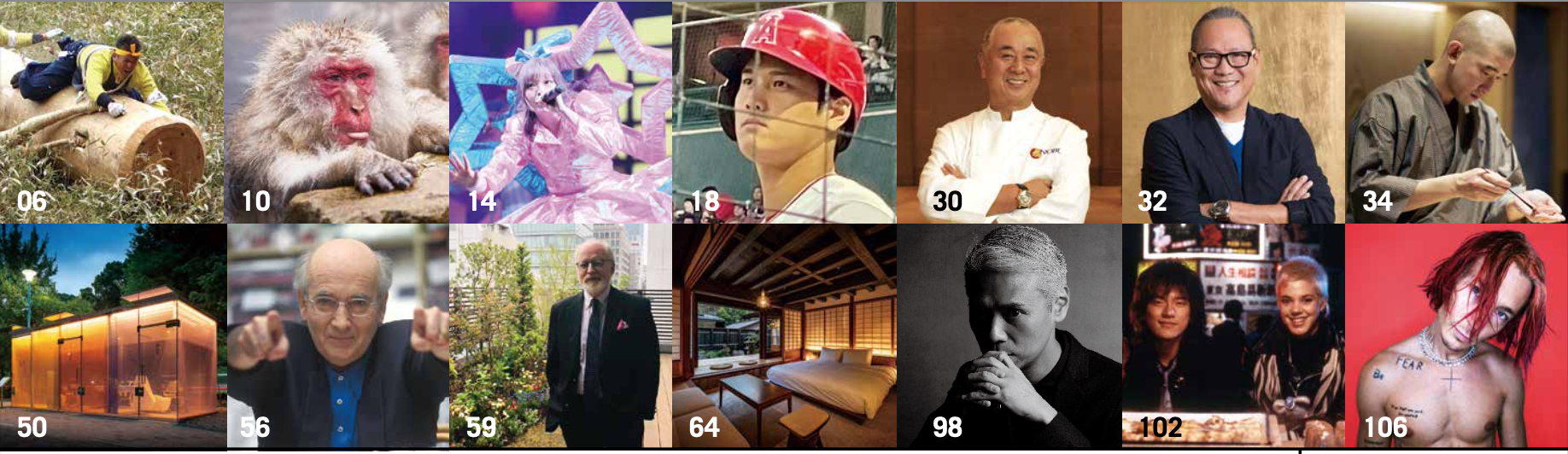
Contents |
|
| 1. Tokyo Journal Editorial (二ヵ国語) Inside this issue |
13. Mizuhiki (二ヵ国語) Handcrafting rope with a wish for your gift |
| 2. Onbashira (二ヵ国語) The most dangerous festival in Japan |
14. Pritzker Laureate Shigeru Ban A humanitarian architect |
| 3. Nagano Nostalgia Historian Peters Grilli recounts his travels |
15. Two Stonecutters (二ヵ国語) Zen wind from Tasaka Juku |
| 4. Kyary Pamyu Pamyu (二ヵ国語) Queen of kawaii headlines Coachella in California |
16. Philip Kotler, the Father of Marketing Marketing master shares his insight |
| 5. Shohei Ohtani (二ヵ国語) Japan’s gift to America |
17. Mixed Methods Research Pioneer Dr. John Creswell blazing new trails in research |
| 6. The Westin Anaheim Resort Look into Disneyland from this 4-star resort |
18. More Travels with Tani The late Donald Richie’s travels to Sado |
| 7. Gastronomic Sake Cuisine compatibility |
19. Great Japanese Hotels to Visit After COVID-19 (二ヵ国語) Travel destinations that opened during the pandemic |
| 8. Nobu Sashimi Salad with Matsuhisa Dressing Acclaimed Chef Nobu Matsuhisa’s recipe |
20. International Art Contest (二ヵ国語) Japanese college art on display in Santa Monica, California |
| 9. Sticky Ribs Iron Chef Masaharu Morimoto’s recipe |
21. Mondo Grosso DJ Shinichi Osawa collabs with Ryuichi Sakamoto & more |
| 10. Michelin-Starred Sushi Kimura Singapore’s sushi chef Tomoo Kimura |
22. I Love Dance (二ヵ国語) Fashion designer Junko Koshino’s ode to dance |
| 11. Ponzu (二ヵ国語) The tangy sauce and its unique ingredients |
23. Tokyo Pop and Carrie Hamilton Legendary photographer Bob Gruen’s Japan pics |
| 12. Yakisoba Home cooking recipe for stir-fried noodles |
24. Putting on a Happy Face (二ヵ国語) Japanese music fans discover Jagwar Twin |
Four Decades of Rock in Japan

Four Decades of Rock in Japan
Legendary Rock Photographer Bob Gruen in Japan
I first arrived in Japan with Yoko Ono in August 1974. I stood behind her as the plane door opened, and I followed her as she walked down the stairs into a crowd of photographers. She was on tour in Japan with a band of top musicians.
Product Reviews: Staying at Home in Style

Product Reviews: Staying at Home in Style
Mudras – Hand Seals for Happiness

Mudras – Hand Seals for Happiness
Let’s begin with an exercise. Either seated or standing, take one long, conscious breath–one deep inhale and exhale. Now, make a strong fist with both of your hands and hold it for a moment. Take a mental note as you squeeze your hands. How are you feeling? How is your breath? What feelings arise?
The World’s Greatest Athlete

The World’s Greatest Athlete
How Olympic Decathlete’s Japanese Heritage Led Him to Gold
Bryan Ezra Tsumoru Clay is an Olympic Gold and Silver Medalist, three-time World Champion, and four-time U.S. National Champion in the decathlon, ultimately earning himself the title of “World’s Greatest Athlete” at the 2008 Olympics. Clay was born in Austin, Texas to a Japanese mother and an African-American father who divorced when he was in elementary school. Raised in Hawaii, he moved to California after high school and eventually became a standout athlete on the Azusa Pacific University track team. Clay discussed his entrepreneurial ventures and his African-American/Japanese heritage with Tokyo Journal’s Editor-in-Chief Anthony Al-Jamie.
Inclusion in Tokyo’s Olympic Games

Yoshie Kris, Making Performance Accessible to All
Inclusion in Tokyo’s Olympic Games
Yoshie Kris is a director of Slow Label, an innovative company based in Japan that creates art and creative opportunities to help diversify the community. She is also one of seven creative directors in charge of organizing the opening and closing ceremonies of the Tokyo Olympic and Paralympic Games. Kris is responsible for facilitating engagement between the Tokyo Olympic and Paralympic Games and for ensuring that the opening and closing ceremonies for both events are accessible to all attendees. She has taken inspiration for these tasks from personal experience. She was diagnosed with malignant fibrous histiocytoma (a type of malignant tumor) in 2010, which has cost her the use of her right leg; she has to walk with a crutch. Her passion for the inclusion of all people in society has led her to travel the world to learn about diversity everywhere. Her education and experience brings an innovative and unique perspective to the Tokyo Olympic and Paralympic Games and the ceremonies that will reflect Japanese culture on a worldwide stage. Kris was interviewed by Tokyo Journal’s Editor-in-Chief Anthony Al-Jamie. Kris now waits with the rest of the world for the Olympics to commence.
Being Like a Rock in a Tea Garden

Being Like a Rock in a Tea Garden

Hiroshima Survivor Hideko Tamura Snider

Hiroshima Survivor Hideko Tamura Snider
Educating the World on the Consequences of Nuclear Weapons
Hideko Tamura Snider was a child when the atomic bomb hit Hiroshima in 1945. She later moved to the United States to earn a B.A. in sociology and an M.A. in social work. She has written two books: When A Peace Tree Blooms, a children’s picture book about creating peace in the world, and One Sunny Day, a memoir of her life before the bomb, during the explosion, and afterward in both Japan and the United States. Tamura Snider runs the One Sunny Day Initiatives, an organization that educates the public about the consequences of nuclear weapons and seeks to plant seeds of peace, hope, and reconciliation. Tokyo Journal Editor-in-Chief Anthony Al-Jamie sat down with Hideko Tamura Snider to talk about her experience.


