


Awa Sparkling Sake: International Debut at Tokyo Olympics

Awa Sparkling Sake: International Debut at Tokyo Olympics
Champagnes and sparkling wines have long been used to celebrate milestones from Formula 1 championship wins to weddings. Now, sake has its own sparkling version.
The Four Seasons of Japan

The Four Seasons of Japan
From white to pink to green to red and yellow, the beauty of Japan changes in each of its four distinct seasons. As the country spans 3,000 km from the northeast Sea of Okhotsk to the southwest East China and Philippine Seas, the climate varies greatly. The northern island of Hokkaido has short, mild summers and long winters with heavy snowfalls, while the southern island of Okinawa is subtropical. Japan’s mainland experiences sharp differences from Siberian cold fronts on the western seacoast and warmer sea currents on the eastern Pacific coast.
Hotels in Tokyo

Tokyo Hotels
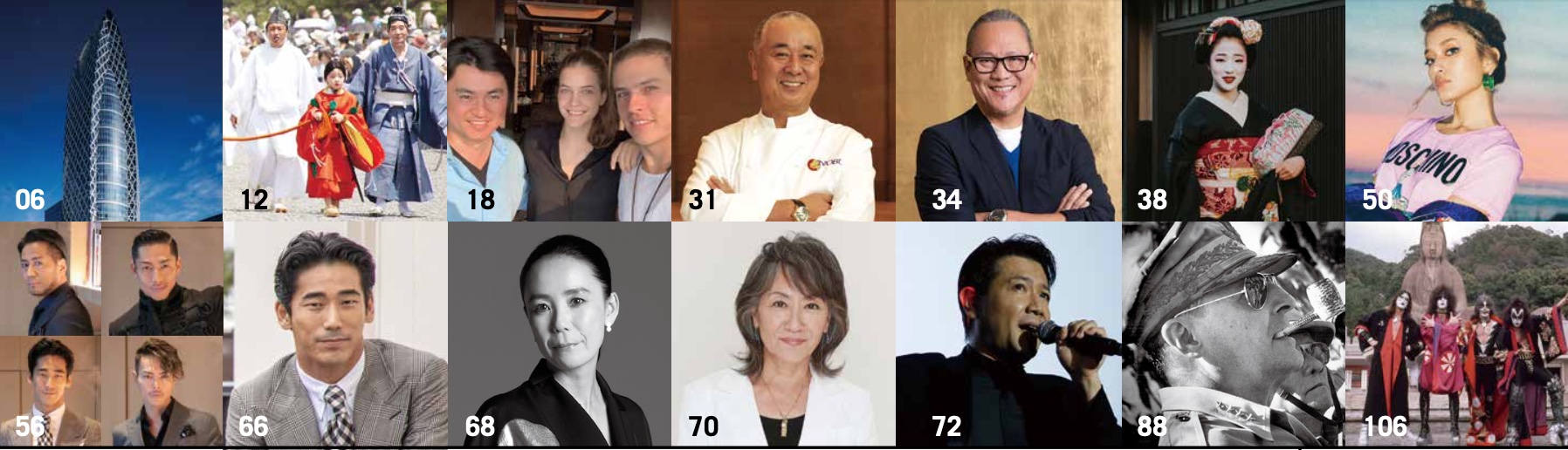
Tokyo Journal sent a celebrity review team to stay at some of Tokyo’s top hotels. Dylan Sprouse is an American actor and entrepreneur. He and his twin brother, Cole Sprouse, are known for their roles on the Disney Channel series The Suite Life of Zack & Cody and The Suite Life on Deck, as well as films including Big Daddy with Adam Sandler. Barbara Palvin is a Hungarian supermodel who was the 2016 Sports Illustrated Swimsuit Issue’s Rookie of the Year, 2019 Victoria’s Secret Angel, and was ranked as one of Forbes’s highest paid models in the world in 2016. Actor Shin Koyamada, who starred in The Last Samurai as Ken Watanabe’s son, has also acted in many Disney Channel programs, including Wendy Wu: Homecoming Warrior.
Kyoto: Japan's Cultural Capital

Kyoto
Japan’s Cultural Capital
Kyoto was Japan’s capital city until 1868. Today, it is widely considered to be the country’s cultural capital for its plethora of Buddhist temples, along with its Shinto (an ancient Japanese religion) shrines, palaces, and gardens. During WWII, U.S. Secretary of War Henry L. Stimson, who had honeymooned in Kyoto, demanded it be removed from the list of targets for the atomic bomb due to the city’s cultural importance. In addition, the city was fortunately spared from large-scale conventional bombing, allowing the preservation of many Japanese cultural treasures. Kyoto is the world’s number one destination for kabuki (classical Japanese theater), flawlessly groomed geishas (traditional entertainers), and blooming springtime sakura (cherry blossoms), as well as bamboo forests, sacred shrines, traditional temples, and delicious, traditional food.
The Tange Legacy: Like Father, Like Son

The Tange Legacy: Like Father, Like Son
An Interview with Architect Paul Noritaka Tange
Paul Noritaka Tange is an architect who graduated from the Harvard University Graduate School of Design in 1985. As the son of Kenzo Tange, one of the most world-renowned architects of the 20th century, Tange was exposed to architecture and design from a very young age. He developed his father’s passion for architecture and joined his father’s firm, Kenzo Tange Associates, where he later became president of the company in 1997. He has since founded his own architectural firm, Tange Associates, and risen to international prominence, designing buildings across Asia and the United States. He has been working hard to prepare for the Olympics in Tokyo, upgrading and designing important features of the Olympic landscape. Tokyo Journal Editor-in-Chief Anthony Al-Jamie spoke with Paul Tange to discuss his current and future projects, including his design role in the upcoming Tokyo Olympics.
TJ: The last time we spoke, you mentioned the prosperity that the Olympics would bring to Japan. It is amazing that since then you have had the opportunity to work on the Tokyo Aquatics Centre, the same type of building that your father created for the Olympics in 1964. Can you tell me a little bit about that?
TANGE: Of course. While our work has taken place during different time periods, we are thankful to have been able to work on the swimming venue in Tokyo. It has been an honor for us both to be able to serve our country for the Tokyo Olympics.
TJ: I understand that you are working on the Yoyogi National Gymnasium project, which was actually built by your father.
TANGE: Yes, we are currently upgrading the building in preparation for the Olympics. While respecting the original design, we have made changes to adjust to the modern expectations of the Olympics. Primarily, we want to ensure that the building is structurally sound in case of an earthquake. We have also worked to upgrade aspects of the gymnasium, including the addition of more comfortable seating and increased accessibility. While we have avoided making too many changes, we hope to achieve the modern Olympic standard.
Osaka: Japan’s Amazing “Water City”

Osaka: Japan’s Amazing “Water City”
Osaka, at the mouth of Odo River on Osaka Bay, is not high on the list of most foreign visitors to Japan, primarily because they know little or nothing about the city beyond its reputation as a business center. That is a major loss. Osaka has the richest history of any of Japan’s leading cities.
Buy the Tokyo Journal
| Buy an In-Print Issue |
|
| INSIDE JAPAN: Single in-print issue: ¥1,000 > Click here OUTSIDE JAPAN: Single in-print issue: $15 > Click here |
|
Buy a Digital Issue and Download it now | |
|
Single digital issue: $15 Click a magazine cover in the bookcase below |
Quarterly Printed Magazine Subscription For residents of Japan only, click here |
Volume 40. Issue #280

Contents |
|
| 1. Tokyo Journal Editorial Inside this issue |
19. Casting Director Yoko Narahashi Hollywood & Japan film industries |
| 2. The Tange Legacy Architect Paul Tange on Kenzo & Olympics |
20. Short Shorts Film Festival & Asia Founder Tetsuya Bessho |
| 3. Kyoto Japan's cultural capital |
21. J-flicks in the USA U.S. releases of Japan-related films |
| 4. Osaka Japan's amazing “Water City” |
22. Film Director Rempei Tsukamoto Bento Harassment |
| 5. Hotels in Tokyo Reviews by Hollywood actors & a supermodel |
23. L.A. Dodgers' Peter O'Malley Ambassador of Japanese baseball |
| 6. Four Seasons of Japan Weather and what to wear |
24. The Auto World's Jim Press Toyota, Chrysler, Carlos Ghosn & int'l business |
| 7. Awa Sparkling Sake Is it champagne? No, it's sake with bubbles |
25. Rakuten Expands Online Magazine Service All-you-can-read magazines |
| 8. Chef Nobu Matsuhisa Broiled black cod with miso recipe |
26. The Warlord and the Wimp |
| 9. Iron Chef Masaharu Morimoto Tuna pizza with anchovy aioli recipe |
27. MacArthur and Me Peter Grilli's encounter with the U.S. General |
| 10. Yakitori Yumiko's homecooking recipe |
28. Life after Hiroshima Mike Kawamura: A survivor's dream for peace |
| 11. Welcoming Foreigners Musician Marty Friedman's advice for tourists |
29. The Consequences of Nuclear Weapons Hiroshima Survivor Hideko Tamura Snider |
| 12. Study in Japan Japanese language schools & Japanese higher ed. |
30. Shadows (二ヵ国語) Hiroyuki Suzuki's photographic poetry |
| 13. Travel to Las Vegas Where to stay |
31. Being like a Rock in a Tea Garden (二ヵ国語) Zen wind from Tasaka Juku |
| 14. Rolling with Rola in L.A. Japanese celebrity & model in California |
32. Inclusion in Tokyo's Olympic Games Yoshie Kris oversees accessibility of Olympic ceremonies |
| 15. Japan House Los Angeles Showcasing Japanese culture in L.A. |
33. World's Greatest Athlete Olympic Decathlon Champion Bryan Clay |
| 16. EXILE J-pop supergroup |
34. Yoga Lifestyle Mudras – Hand seals for happiness |
| 17. Dancer & Actor Naoki Kobayashi From EXILE to Hollywood |
35. Product Reviews Staying at home in style |
| 18. Director Naomi Kawase rom Cannes to the Tokyo Olympics |
36. Four Decades of Rock in Japan Legendary rock photographer Bob Gruen's Japan pics |
Tokyo Journal's Product Reviews

Product Reviews for the Busy Traveler
Move Across Campus with the Swagger E-Scooter
The Swagtron Swagger is an e-scooter that can be used as a fun and easy way to get around. The carbon fiber chassis is strong and durable, without being heavy: it weighs just 17 pounds. The Swagger easily folds down with the touch of a button and stows in tight areas. The 250-watt motor has three speeds, allowing it to zip around at up to 15 miles per hour. The motor is powered by a 24v 3800mAh lithium-ion battery (UL certified), enough for a 15-mile ride on a full charge. The LED backlit display provides useful information such as speed, battery levels and an odometer. Operating the Swagger is simple: there’s one lever to accelerate, another to decelerate.
Yoga: A Wabi-sabi Contemplation

Yoga: A Wabi-sabi Contemplation
In today’s media-saturated world, we’re told that our bodies are not perfect. Everywhere we turn, we feel overwhelmed by the glorified ideals of male and female bodies. There is a sense that we need to live up to these deceiving expectations of beauty and this urges us to purchase more products and services to change our physical appearance or hide our supposed imperfections. It’s so easy to fall prey to this style of consumerism and targeted advertisements that it’s no wonder we get obsessed with looking young and perfect all the time.


