


Inspiring Pride in Haitian Identity

Jeanguy Saintus is the recipient of the 2008 Prince Claus Award. The Prince Claus Fund for Culture and Development website www.prince- clausfund.org/en/network/jeanguy.html has the following to say about this visionary artist:
Jeanguy Saintus is the recipient of the 2008 Prince Claus Award. The Prince Claus Fund for Culture and Development website www.prince- clausfund.org/en/network/jeanguy.html has the following to say about this visionary artist:
Visionary choreographer, dancer and educator, Jeanguy Saintus expresses the rich fusion of Caribbean culture and the contemporary life of his country through the body. He studied anthropology, sociology and languages, taught himself Haitian, classical and modern dance and co-founded Cie Ayikodans, a group that has matured over 20 years,establishing a centre and training programme.
Tsukiji in Tokyo

The world’s largest fish market thrills the senses
WHEN the new facilities for Tokyo’s Tsukiji Market were opened in 1935, the architects probably never imagined it would become such a popular tourist attraction. People from all over the world come in vast numbers to see the globe’s largest fish market, employing more than 60,000 people.
Especially popular is the early morning tuna auction. Men clad in blue and wearing black rain boots yank steel hooks into the exposed rear ends of hundreds of frozen tunas laid out on the concrete floor of one section of the market. With small flashlights, they quickly check the quality of the tuna. Few words are uttered. Most men walk quietly from fish to fish, careful not to let competitors know which tuna they like best.
As the auction starts, a man standing on a wooden stool shouts identification numbers and prices. Brokers place their bids, almost unnoticeably. It’s quiet, restrained, organized. You wouldn’t know that enormous amounts of money change hands. In January, a single bluefin tuna fetched a record price of 155 million yen ($1.7 million or £1.05 million).
The complete article is available in Issue #271. Click here to order from Amazon
Where Tradition Meets Modern Taste

Morita Nenohi is a legendary sake brewer south of Nagoya, Japan. It was established in 1665 by the Moritas, a family best known for the fifteenth head of the family business: Sony co-founder Akio Morita. Nenohi is a dry, well-balanced sake.
Legendary Morita Nenohi Sake
It is made using traditional techniques augumented with modern spirits to produce a satisfying taste for a wide range of people around the world. It can be savored chilled, warm or at room temperature.
The following is Morita’s traditional brewing process for the Nenohimatsu “Super Premium Daiginjo (Fine Rice Sake):
Aloft is Alift for the Senses

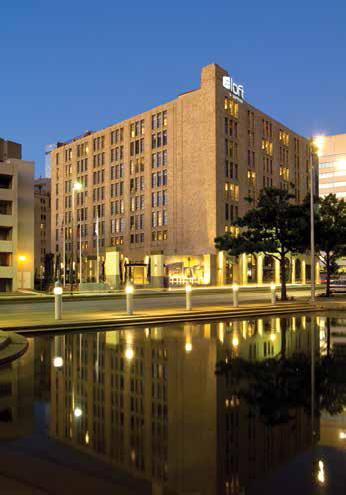
AS I walked into the lobby of the Aloft Downtown Dallas hotel, I wasn’t expecting much out of the ordinary in this historic-looking, factory- type building in downtown Dallas.
AS I walked into the lobby of the Aloft Downtown Dallas hotel, I wasn’t expecting much out of the ordinary in this historic-looking, factory- type building in downtown Dallas. But I immediately did a double take. It looked like I’d wound up at a mixture of a hip nightclub, art gallery, and trendy café. Soon enough, however, I was pleasantly surprised to find I was where I wanted to be: the Aloft Downtown Dallas.
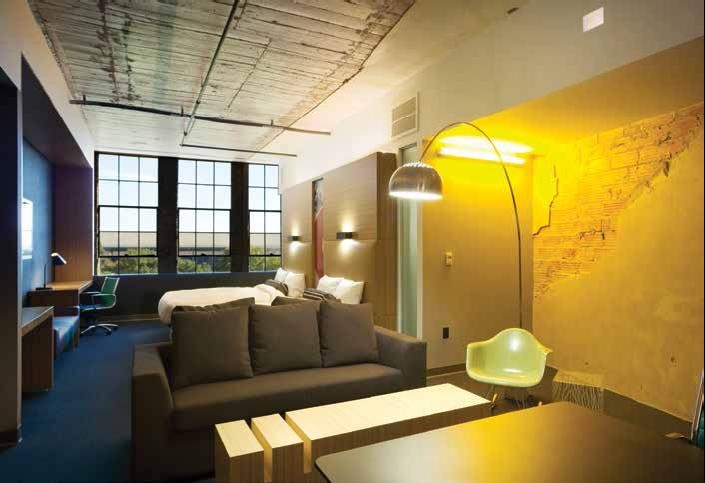
Owned by Starwood Hotels & Resorts, the group that also has chains like Westin, Sheraton, W Group, Regis and Le Méridien, Aloft is an enjoyable change from the norm. I don’t usually wander hotel corridors to admire the interior design, but Aloft inspired me to do so. When I first checked into my room, I had to stroll around a few times to take it all in. After I sat down to relax, I walked around the room again just to see if I’d missed anything (which I had!). Then looking out my window across the street at the Dallas Convention Center, train station and City Hall, I was reminded how conveniently located the hotel is. For frequent travelers, hotels are a blur of similar designs. That’s not the case with Aloft. It is a lift for the senses.
Aloft is a “select” service hotel that does not have bellmen but caters to on-the- move business-savvy travelers who know what they want. The other primary segment of their clientele includes guests attending conferences at the convention center across the street.
AS I walked into the lobby of the Aloft Downtown Dallas hotel, I was not expecting much out of the ordinary in this historic-looking, factory- type building in downtown Dallas. But I immediately did a double take. It looked like I had wound up at a mixture of a hip nightclub, art gallery, and trendy cafe. Soon enough, however, I was pleasantly surprised to find I was where I wanted to be: the Aloft Downtown Dallas.
Aloft is a self service hotel that does not have bellmen but caters to on-the-move business-savvy travelers who know what they want. The other primary segment of their clientele includes guests attending conferences at the convention center across the street.
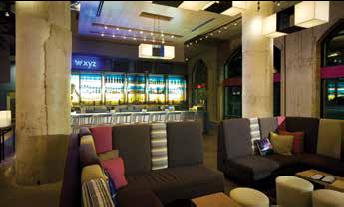
The lobby has different areas to relax in: a bar, lounge and a self-serve snack and coffee area that has a “build your own” fresh and hot breakfast and complimentary coffee in the morning. All of the decor appears out of the latest interior design magazine. I don’t think I’ve ever seen rocking chairs in a hotel lobby before, but the modern-retro design made the chairs fit right in. At night, the hotel is a great place to mix and mingle by enjoying a glass of vino at the w xyz bar, or a game of pool in their re:mix lounge. Both are located in the lobby area.
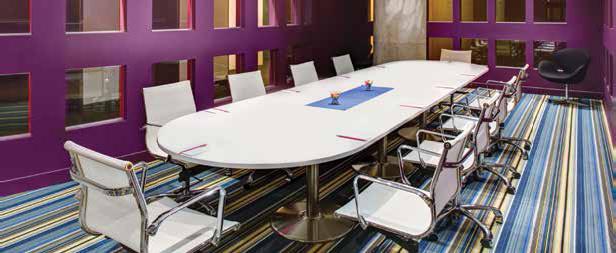
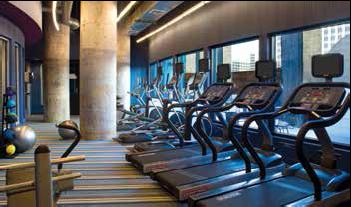
There are event and meeting spaces of various sizes throughout the building. The event facilities are extremely vibrant and trendy and have been used for After Parties; by celebrities such as Britney Spears and Jamie Foxx. The hotel is pet friendly and smoke-free. Free WiFi is available throughout the building. There are 24-hour business and fitness centers, an outdoor pool, onsite parking and Blink electric car charging stations. Rooms come with complimentary coffee, tea and bottled water. Standard rooms are 350 to 475 square feet with one TV. Suites are 450 to 775 square feet with a larger meeting and work area and two TVs, one in the work area and one for the bed and living area. The 42” LCD TVs have ports for connecting laptops or other electronic devices.
Aloft Hotels take part in adaptive reuse projects to provide benefits to communities in search of urban renewal opportunities, and the Aloft Downtown Dallas is no different. Built originally in 1925 as part of the Santa Fe Terminal Complex, then owned by the Haggar Clothing Co. which used the facilities to produce military uniforms during World War II, the building was renovated and opened as a hotel in 2009.
For the sustainability minded guest, there is plenty with re-used demolition debris, natural materials and built-in liquid soap and shampoo dispensers.
 |
|
|
 |
 |
|
 |
 |
|
 |
||
Hiroyuki Suzuki Photo Exhibit Interview #2

Hiroyuki Suzuki's camera lens has taken him to construction sites around the world in an ambition to capture the instability, energy, beauty and hope – he sees as intrinsic within these sites.
Hiroyuki Suzuki
TJ: How and why did you get interested in this style of photography?
Suzuki: I shoot pictures of buildings, not people. However, my pictures can tell people there was a process that went into the history of a building, and there were people involved in the development and timeline of the building. Although very few of my pictures have people in them, it is my hope that people, who look at my pictures, see that people were involved in the creation of that building or thing.
My sensitivity is very sharp for seeing a picture perfect moment and I can see when 1 +1 = 3 very quickly. In 2006, I instantly captured the moment for a striking picture of a bridge being built where the opposite sides were created, but the middle joining piece was missing. I like to photograph very unusual or shocking moments like that. It’s like making a documentary movie and I feel like I’m like a war journalist. For example, if I see a bridge being built while driving to work in the morning, I know it might look very different when I go back home at night, so I have to quickly react to photograph it as soon as possible.
建築の瞬間
TJ: この撮影スタイルにこだわるようになった いきさつは?
スズキ: 私は人でなく建物の写真を撮ります。 でも私の写真は、建物の歴史を物語る移り変わ りがあり、建物の発展と来歴に関わった人たち がいたことを、見る人に語りかけることができ ます。私の写真に人間が写りこむことはほとん どないのですが、わずかな例外の場合も、その 建物やモノの創造に関わった人であることを感 じてもらえればと思います。
写真についての完璧な瞬間に対する私の感性は 非常に鋭く、1+1 が3 になる瞬間を即座に見 極めることができます。2006 年には、建設中 の橋の決定的瞬間をとらえました。両側が作 られていて中央の結合部分が欠けた格好の橋で した。私は、そうした普通でない、あるいは衝 撃的な瞬間を撮影したいのです。ドキュメンタ リー映画の制作に通じるところもあり、従軍 ジャーナリストのような気がしています。たと えば、朝の通勤途中に建設中の橋を見かけたと します。夜、家に帰る頃には全く違う光景に
Fashion Design by Junko Koshino

Tokyo's Fashion Queen and Tony Award-nominee Junko Koshino, renowned for her fashion, costume and uniform design, shares the latest in Tokyo's fashion scene.
Junko Koshino
TJ: Can you tell us about your recent projects?
Koshino: In 2012, I did the costume design for The Art of Japan Drum “Drum Tao” and the launch of the Cashmere 2012 Autumn Winter Total Collection Line. Projects in 2013 include the March costume design for the Yuzuru (Twilight Crane) Opera in Vietnam and a museum exhibition in Sao Paulo in November.
TJ: In recent years, what do you think have been the most significant changes in women’s fashion?
Koshino: I think artistic sensitivity has increasingly been freely expressed in women’s fashion designs.
ファッション・衣装・ユニフォームのデザインで知られ、 トニー賞にもノミネートされた東京のファションクイーン コシノ・ジュンコさんに、 東京のファッション・シーンの最新情報を語っていただきました。
TJ: 最近のお仕事についてお聞かせください。
コシノ: 2012 年の活動としては、和太鼓を使っ たアート・パフォーマンス「ドラム・タオ」の 衣装デザイン、カシミヤのトータルコレクショ ンラインのスタート(2012 年秋冬コレクショ ン)などが挙げられます。2013 年には、ベト ナムでのオペラ「夕鶴」公演の衣装デザイン、 11 月のサンパウロのミュージアムでの展覧会 などを予定しています。
TJ: 近年のウィメンズファッションで、最も大 きな変化だと思われるのは?
コシノ: アーティステックな感性がデザインに 現れ、より自由になったと思います。
Mari’s Homemade Cooking Recipes

Ingredients
• 250g of sliced pork or beef
• Lettuce
• 1 tablespoon of soy sauce
• 1 tablespoon of mirin
• 1 tablespoon of miso
• 1/2 tablespoon of sake
Meat filling
Ingredients
• 250g of sliced pork or beef
• Lettuce
• 1 tablespoon of soy sauce
• 1 tablespoon of mirin
• 1 tablespoon of miso
• 1/2 tablespoon of sake
Samurai #1: Akio Morita

Article by Anthony Al-Jamie (continued)
AKIO Morita was born the eldest son of a sake brewer and was groomed from childhood to take over as the fifteenth head of what is now a 400-year-old sake brewery. Morita studied physics at Osaka Imperial University. After graduating in 1944, he joined the Japanese Imperial Navy, where he met his future business partner, Navy researcher Masaru Ibuka.
Samurai #2: Akira Kurosawa

Article by Anthony Al-Jamie (continued)
Akira Kurosawa was born in Tokyo and from a young age was inspired by art and reading. He began his film career as an assistant director for the renowned Japanese director Kajiro Yamamoto. Kurosawa was well read, and Yamamoto appreciated his vast knowledge. Within five years Kurosawa was writing scripts and directing sequences for Yamamoto’s films. In addition to being a great filmmaker, Kurosawa had an eye for selecting actors. He chose people with strong emotions and distinct facial expressions. He went on to make some 30 movies, many featuring his favorite leading actor Toshiro Mifune.
Samurai #3: Soichiro Honda

Article by Anthony Al-Jamie (continued)
SOICHIRO Honda was born in Shizuoka, Japan. His father, a blacksmith, owned a bicycle repair shop and Honda spent his early childhood helping him fix bikes. As a child, he was fascinated by airplanes and it is said that after he viewed an airplane demonstration by pilot Art Smith, Honda’s love for machinery and invention was instilled in him forever.


